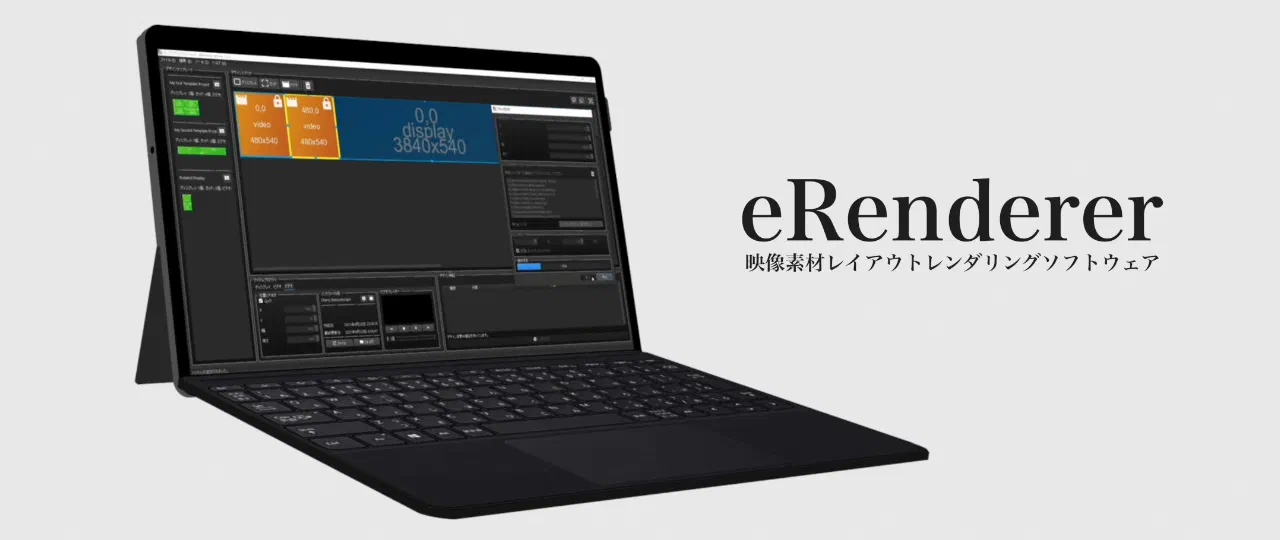
A large LED vision at a commercial complex. An ultra-wide signage running across a station concourse. An LED wall at an event venue. A composition spanning multiple displays — to make these “eye-catching” presentations work, you need video that stays in perfect sync across the displays and content composed at the actual resolution of the surface. eRenderer is content preparation software for digital signage that lets teams build that kind of ambitious visual production without specialist tools, in-house, again and again.
Large display arrays at commercial complexes, stations, airports, and event venues. Each is an attention magnet on its own, yet building the content that takes advantage of them has long been heavy work.
Composing across multiple displays. Building layouts dedicated to ultra-wide screens. Splitting a single composition across an LED wall. Unifying multiple tenants’ videos into one vision. Until now, this kind of production has typically meant either acquiring specialist tools like After Effects, or commissioning an external production partner. Handling it in-house carried the skill-acquisition cost; sending it out carried days of lead time from commission to delivery.
And once you set out to assemble multiple video files into a coordinated presentation, aligning the timebase across those files became a slow, painstaking task that landed on the editor. Whether the intent was to compose on the playback side or to split the output across multiple displays, it was the act of aligning the source materials itself that created the friction. Between the on-site ambition for “eye-catching” presentations and the cost of implementing them — time, skill, and timing — there was a clear gap.
eRenderer was designed so that the expressive range of specialist tools could be reached by anyone who works with a PC. Everything from synchronized multi-video integration to multi-display split output can be assembled on the floor.
eRenderer’s design distills three omissions — “don’t push the playback environment too hard,” “don’t depend on specialist tools,” “don’t spend days going back and forth on production” — into a shape that’s straightforward to put to work on site. Because our development team handled everything from specification through architecture design, software implementation, and user interface as a single continuous effort, the result lets people without specialist skill assemble ambitious visual production in-house.
eRenderer is one of our early products in the horizontal LED display space. The underlying design judgments — “making professional systems work on general-purpose PCs” and “rethinking where computational load should be handled, as a design decision in itself” — have carried over to later products at different uses and scales, taking different shapes.
What we deliver is content preparation software for signage. What is being created on the ground, however, is the freedom to keep redoing — in-house, as many times as the team needs — the kind of ambitious visual production that used to be bottlenecked by time and specialist skill.